

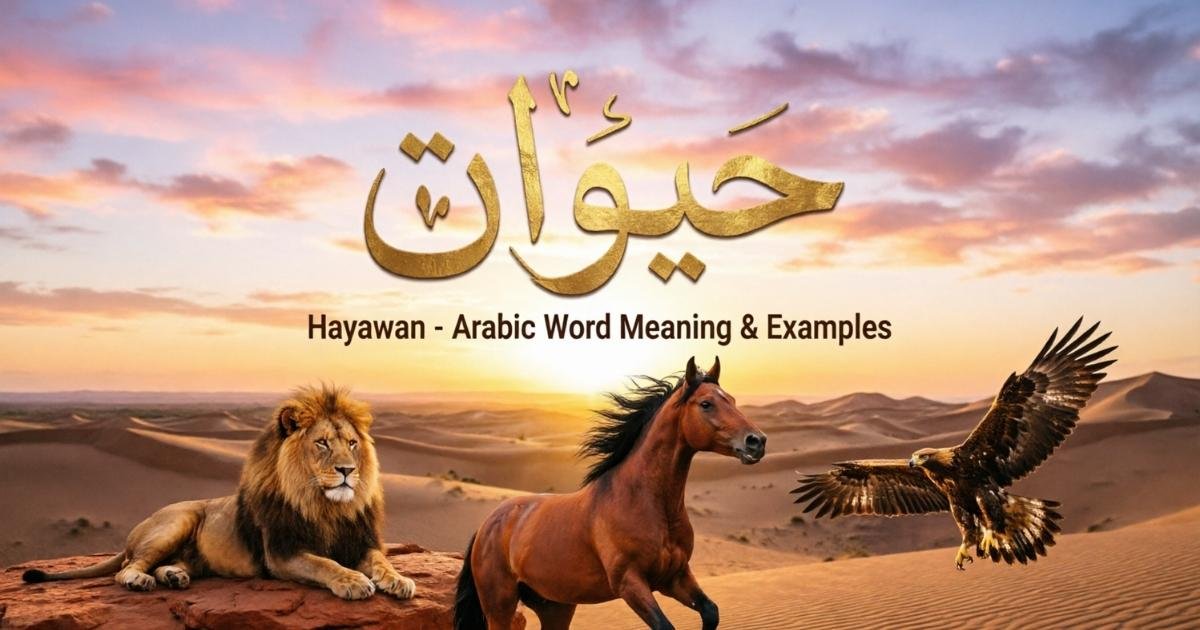
If you’ve ever heard someone say “ya haywan” in a conversation or online and felt confused or even a little shocked, you’re not alone. Many people search for Hayawan Meaning because they are unsure whether it’s an insult, a joke, or something deeper in Arabic. It often comes up in phrases like ya haywan meaning, ya hayawan, and ya hayawan , leaving readers curious about its real sense and usage.
In this blog, we will clearly explain what does haywan mean in Arabic and break down its everyday usage in a simple way. You’ll also understand expressions like ya haywan arabic meaning and how context changes the tone of the word. By the end, everything about Hayawan Meaning will feel easy, clear, and exactly what you were looking for.
The Meaning of “Hayawan” in Arabic
The word “Hayawan” in Arabic refers to a living creature or animal. It comes from classical Arabic and is widely used in both everyday language and formal texts. When people search for Hayawan Meaning, they usually want to understand how this word connects to animals and life in Arabic vocabulary.
In simple terms, “Hayawan” describes any being that has life, especially animals. It is often used in contrast with humans in Arabic grammar. This word helps learners understand basic Arabic vocabulary related to nature and living things.
Linguistic Root and Grammatical Usage

Have you ever noticed how a single Arabic word can carry layers of meaning? That’s exactly what makes “Hayawan” so interesting. It’s not just a simple word for animals, it also connects deeply to Arabic grammar and word formation. When people search for Hayawan Meaning, they are often surprised by how rich its structure really is.
In Arabic, words are built from roots, and this is where “Hayawan” becomes more meaningful. It is linked to the root system that helps form many words related to life, movement, and living beings. Let’s break it down in a simple and friendly way so it’s easy to understand.
Singular vs. Plural Forms
In Arabic, “Hayawan” is generally treated as a singular noun when referring to one living creature or animal. However, the plural form changes depending on context and usage. The common plural form is “Hayawanat,” which refers to multiple animals or living beings.
For example, you might say:
- One animal: Hayawan
- Many animals: Hayawanat
This simple shift helps learners understand how Arabic nouns naturally change. It’s a small rule, but it makes a big difference in communication.
Root Significance
The word “Hayawan” comes from the Arabic root connected to life and living energy. This root also links to words like “Hayat,” which means life. So, when you explore Hayawan Meaning, you are actually stepping into a wider world of Arabic vocabulary related to existence itself.
Think of it like a tree. The root is life, and different words grow from it like branches. This makes Arabic both logical and deeply expressive at the same time.
Sentence Placement
In Arabic sentences, “Hayawan” usually appears as a noun, either as a subject or object. Its position depends on what you want to say. For beginners, it’s helpful to remember that Arabic often follows a Verb-Subject-Object structure, but it can change.
For example:
- The animal eats → The Hayawan eats
- I saw an animal → I saw a Hayawan
This flexibility allows speakers to express ideas clearly while keeping the sentence natural and smooth.
Cultural and Contextual Usage
“Hayawan” is not only a grammatical word, it also appears in cultural and everyday speech. In some contexts, it can simply mean an animal, but in casual conversation, tone and usage matter a lot.
For instance, calling someone “ya haywan” can sound rude or insulting depending on tone. So understanding ya haywan meaning is important before using it in real life. It shows how context changes meaning in Arabic communication.
Pronunciation and Learning Tips
Pronouncing “Hayawan” is quite simple once you break it down: Ha-ya-wan. The emphasis is smooth, not harsh, and each syllable flows naturally. Listening to native speakers helps a lot in mastering it.
A helpful tip is to practice with related words like “Hayat.” This builds a strong connection in your mind and makes learning easier. Also, repeating small words daily improves memory faster than trying to learn everything at once.
Read More:The Word Jazakallah Khair Meaning in Arabic With Examples
Examples of Usage
The word “hayawan” is commonly used in Arabic to describe living creatures in different situations. When you understand Hayawan Meaning, it becomes easier to see how the word appears in daily speech and simple sentences.
Usage Examples
- It is used to refer to any living creature in general conversation
- Often appears when talking about animals in nature or the wild
- Used in school lessons when learning basic Arabic vocabulary
- Can describe pets in a home environment like cats or dogs
- Found in descriptions of farm life and rural settings
- Appears in reading passages about wildlife and environment
- Helps explain living beings in both simple and formal Arabic writing
Grammatical Table
Understanding how “hayawan” works in grammar helps you use it correctly in Arabic sentences. When you learn Hayawan Meaning, you also start seeing how the word changes based on number and context in a simple way.
Grammatical Table Points
| Form Type | Usage Explanation |
| Singular Form | Refers to one living creature or animal in a sentence |
| Plural Form | Used when talking about more than one animal or living being |
| Definite Form | Used when the animal is specific or already known in context |
| Indefinite Form | Refers to any general animal without specifying which one |
| Subject Role | Acts as the main doer of the action in a sentence |
| Object Role | Receives the action within the sentence structure |
| Descriptive Use | Helps describe characteristics of living beings in simple Arabic usage |
Examples of “Hayawan” in Arabic Sentences
The word “hayawan” is used in Arabic sentences to describe living creatures in simple and clear ways. When learners understand Hayawan Meaning, it becomes easier to recognize how the word appears in real Arabic grammar and everyday communication.
In Arabic language learning, this word often appears in basic vocabulary lessons, storytelling, and descriptions of nature or animals. It can be used in both neutral and descriptive contexts depending on the sentence structure.
- In a simple context, it refers to any living creature found in nature or daily life. For example, it can describe an animal seen in a park or farm without any emotional tone.
- In educational sentences, it is used to teach Arabic learners about animals and basic vocabulary structure, making it a common word in textbooks.
- In negative or informal speech, the word may carry a rude tone if used toward a person, so context is very important in Arabic communication.
- In descriptive writing, it helps explain types of animals such as wild, domestic, or aquatic creatures in a clear and structured way.
- In general usage, it remains a neutral term, but its meaning shifts slightly depending on tone, grammar, and cultural setting.
Common Sentences
The word “hayawan” is often used in simple Arabic sentences to describe animals in daily life. When you understand Hayawan Meaning, it becomes easier to recognize how it appears in basic conversations and learning materials. It usually refers to any living creature in a clear and direct way.
For example, people may say a sentence to describe an animal they see in nature or at home. It can also be used in school lessons to teach basic Arabic vocabulary. You might hear it in phrases about pets, farm animals, or wildlife. These common sentences help learners understand real usage and improve their Arabic communication skills step by step.
Types of Hayawan (Animals)

Have you ever thought about how many different kinds of living creatures surround us every day? From pets at home to fish in deep oceans, the world of animals is much bigger than we usually notice. When people search for Hayawan Meaning, they often also want to understand the different types of hayawan in real life and language.
In simple terms, “hayawan” in Arabic covers all kinds of animals and living creatures. It is a broad word, not limited to one group. Let’s explore the main types so you can clearly see how Arabic vocabulary connects with nature around us.
Domestic Animals
Domestic animals are the ones we live with or keep close to our homes. They are friendly and often depend on humans for care and food.
For example, cats, dogs, and rabbits are common domestic animals. Many people treat them like family members. In Arabic usage, these are still called hayawan because they are living beings, even though they live among humans.
Key idea:
- They live with humans and adapt easily to home life
- They often build emotional bonds with people
- They are part of daily life in many cultures
Think of a cat sitting on your couch or a dog waiting at the door. That’s domestic life in action.
Farm Animals
Farm animals are those raised for food, work, or farming purposes. They play a big role in agriculture and rural life.
Cows, goats, chickens, and sheep are classic examples. These animals help provide milk, meat, eggs, and even labor in some places. Without them, farming life would be very different.
Key idea:
- They support human survival through food and products
- They are usually kept in controlled environments like farms
- They are deeply connected to rural economies
It’s like a partnership between humans and animals where both depend on each other in different ways.
Wild Animals
Wild animals live freely in nature without human control. They are often found in forests, deserts, and mountains.
Lions, wolves, elephants, and deer are all wild animals. They survive by hunting or adapting to natural environments. Unlike domestic animals, they are not meant to live with humans.
Key idea:
- They live independently in natural habitats
- They follow survival instincts for food and safety
- They maintain ecological balance in the environment
A lion in the jungle or an eagle in the sky reminds us how powerful and independent nature can be.
Aquatic Animals
Aquatic animals live in water—oceans, rivers, lakes, and even ponds. Their entire life depends on water environments.
Fish, dolphins, whales, and octopuses are well-known examples. These creatures are adapted to swim, breathe, and survive underwater in unique ways.
Key idea:
- They live fully or partially in water
- They have special body features for swimming and breathing
- They are essential for marine ecosystems
Imagine an ocean full of colorful fish moving like a silent underwater city. That’s the beauty of aquatic life.
Insects and Small Creatures
Insects and small creatures are often overlooked, but they are everywhere around us. They may be tiny, but their role in nature is huge.
Ants, bees, butterflies, and spiders are common examples. Bees help in pollination, while ants work in organized colonies. Even though they are small, they are powerful contributors to the ecosystem.
Key idea:
- They are the most diverse group of animals
- They play key roles in pollination and soil health
- They often work in highly organized systems
A single bee visiting flowers might look simple, but it supports the entire food chain.
Cultural or Quranic Significance of “Hayawan”

The word “hayawan” holds importance in Arabic culture because it reflects the idea of living beings and creation. In deeper understanding, Hayawan Meaning also connects with life, nature, and existence in a broader sense. It helps learners see how Arabic describes living things in a simple and meaningful way.
Cultural & Quranic Related Points
| Aspect | Explanation |
| Living Creation | Refers to all beings that have life in Arabic understanding |
| Nature Connection | Shows how animals are part of natural balance in the world |
| Language Use | Appears in classical Arabic to describe living creatures |
| Educational Value | Helps students understand basic Arabic vocabulary structure |
| Cultural View | Reflects respect for all forms of life in society |
| Linguistic Depth | Connects with root words related to life and existence |
| Learning Importance | Useful for understanding Arabic texts and meanings clearly |
Common Misunderstandings or Mistakes
Many people think they fully understand Arabic words at first glance, but small details can completely change the meaning. That’s especially true with words like “hayawan,” where context, tone, and grammar all matter. When learners search for Hayawan Meaning, they often miss these small but important mistakes that can lead to confusion.
In simple terms, these misunderstandings happen because Arabic is a context-rich language. A word can sound simple, but its usage can shift depending on situation, pronunciation, or even culture. Let’s break down the most common mistakes so you can avoid them easily.
Using “ya haywan” incorrectly
One of the most common mistakes is using “ya haywan” without understanding its tone. In many real-life situations, this phrase can sound rude or insulting if used carelessly.
For example, friends might say it jokingly in some cultures, but in serious conversations it can feel offensive. It’s like calling someone “animal” in English—it depends heavily on tone and relationship.
Key insight:
- Always be careful with tone and context
- Never use it with strangers or elders
- Understand it can shift from joke to insult quickly
So before using phrases related to ya haywan meaning, always think about who you are speaking to.
Mixing singular and plural forms
Another common mistake is confusing “hayawan” (singular) with “hayawanat” (plural). Beginners often assume they are interchangeable, but they are not.
For example, saying “many hayawan” is incorrect in proper Arabic grammar. Instead, “hayawanat” should be used for multiple animals.
Key insight:
- “Hayawan” = one animal
- “Hayawanat” = many animals
- Mixing them can change meaning or sound unnatural
It’s like mixing “cat” and “cats” in English—you’ll still be understood, but it won’t be grammatically correct.
Assuming it only refers to wild animals
Some learners believe “hayawan” only means wild animals like lions or wolves. That’s not true at all.
In reality, the word includes all living animals—pets, farm animals, wild creatures, and more. It is a general term, not a limited category.
Key insight:
- It covers all animal types
- Not limited to dangerous or wild species
- Used broadly in Arabic vocabulary
Think of it as a big umbrella that covers every living creature except humans.
Ignoring cultural context
Language is not just grammar—it’s culture too. One big mistake is ignoring how words are used socially.
In Arabic-speaking cultures, words like “hayawan” can carry emotional weight depending on tone. Using it casually in the wrong situation might create misunderstanding.
Key insight:
- Meaning changes with social context
- Same word can sound polite or rude
- Cultural awareness is essential for correct use
It’s similar to how tone changes meaning in English slang or expressions.
Pronunciation errors
Many beginners also mispronounce “hayawan,” which can lead to confusion. Small changes in sound can make the word sound unnatural or unclear.
The correct pronunciation is smooth: Ha-ya-wan. Each syllable should flow evenly without stress on one part.
Key insight:
- Break it into syllables for easier learning
- Practice slowly before speaking fast
- Listening to native speakers helps a lot
A good trick is to repeat it like a rhythm rather than a single rushed word.
Read More:Powerful Prayer for Typhoon and Flood
Correct Usage Tips:
Using Arabic words correctly can completely change how natural you sound in conversation. The word “hayawan” is a perfect example because a small mistake can shift meaning or tone. When learners understand Hayawan Meaning, they also learn how to use it safely and correctly in real situations.
In simple terms, correct usage is about choosing the right context, tone, and grammar. It’s not just about knowing the word, but also knowing when and how to say it. Let’s go through some practical tips that make your Arabic more accurate and natural.
- Pay attention to context before speaking
The meaning of “hayawan” changes depending on situation. In neutral speech, it means an animal or living creature. But in informal talk, using it toward a person can sound offensive. Think of it like English words that are fine in science class but rude in casual speech if misused. - Use the correct form: singular or plural
One common mistake learners make is mixing “hayawan” and “hayawanat.” If you are talking about one animal, use “hayawan.” If you are referring to many, use “hayawanat.” This small detail helps your Arabic sound more natural and grammatically correct. - Match tone with relationship
Arabic is very sensitive to tone. Even if the word is correct, the way you say it matters. For example, calling a friend “ya haywan” might be joking in some cultures but disrespectful in others. Always adjust your tone based on who you are speaking to. - Learn through real-life examples
Instead of memorizing rules, try using the word in simple sentences like describing pets, farm animals, or wildlife. For example, saying “This hayawan meaning is in the garden” helps you connect meaning with real situations, making it easier to remember. - Understand cultural sensitivity
One lesser-known fact is that Arabic words often carry emotional weight. “Hayawan” can be neutral in textbooks but emotional in conversation. Learning this difference helps you avoid misunderstandings and communicate more respectfully.
Why You Should Learn “Hayawan”
Have you ever noticed how one simple Arabic word can open the door to a whole world of meaning? That’s exactly what happens with “hayawan.” It’s not just vocabulary, it’s a way to understand life, culture, and communication in Arabic. When learners explore Hayawan Meaning, they often realize it connects much deeper than just “animal.”
In simple terms, learning “hayawan” helps you understand how Arabic works in real situations. It connects language with daily life, culture, and even religious texts. Let’s look at why this small word is actually very powerful for learners.
Connect with real-life Arabic
Learning “hayawan” helps you understand how Arabic is used in everyday conversations. It appears in simple speech, stories, and descriptions of nature.
For example, when someone talks about animals in daily life, this word naturally comes up. It’s like learning the word “animal” in English—it shows up everywhere once you start noticing it.
Key insight:
- Helps you recognize real-life Arabic speech
- Builds confidence in basic conversations
- Makes everyday vocabulary easier to understand
Think of it like learning the word “water” in a new language—you suddenly see it everywhere.
Understand cultural expressions
Arabic is rich with expressions, and “hayawan” sometimes appears in emotional or cultural contexts. Understanding it helps you avoid confusion in real conversations.
For instance, tone can completely change how the word feels. That’s why knowing ya haywan meaning is important for proper communication.
Key insight:
- Helps you understand tone and emotion
- Prevents misunderstanding in conversations
- Gives deeper cultural awareness
It’s like learning slang in English—you don’t just learn the word, you learn how people feel when they say it.
Learn grammar and roots easily
One of the best things about “hayawan” is that it helps you understand Arabic root systems. Arabic words are built from roots, and this makes learning much easier.
Once you understand Hayawan Meaning, you also start noticing related words like “hayat,” which means life.
Key insight:
- Teaches Arabic root patterns naturally
- Helps connect related words easily
- Improves grammar understanding over time
It’s like learning one puzzle piece that helps you complete many others.
Gain insights from religious and classical texts
Arabic is deeply connected to religious and classical literature. Words like “hayawan” often appear in older texts, giving learners a bridge to understanding deeper meanings.
This is especially useful for students reading Islamic or classical Arabic material.
Key insight:
- Appears in classical Arabic usage
- Helps in understanding religious texts
- Builds stronger language foundation
It’s like having a key that unlocks older, richer forms of the language.
Enhance vocabulary retention
Learning “hayawan” also helps improve memory because it connects with visual and real-life examples. Animals are easy to imagine, so the word sticks in your mind longer.
When learners connect words with real images, retention becomes much stronger.
Key insight:
- Easier to remember through visuals
- Strengthens long-term vocabulary learning
- Improves language learning speed
Think of it like remembering a picture instead of just a word—it stays longer in your mind.
Frequently Asked questions
Is Hayawan used in the Quran?
Hayawan Meaning is related to life and animals, but the word itself is not commonly used in the Quranic text directly.
What is the plural of Hayawan meaning in Arabic?
Hayawan Meaning plural is Hayawanat, which refers to multiple animals or living creatures in Arabic grammar.
How to pronounce Hayawan meaning in Arabic correctly?
Hayawan Meaning is pronounced Ha-ya-wan, with smooth and equal syllables for correct Arabic pronunciation.
What is the root of Hayawan Meaning in Arabic?
Hayawan Meaning comes from a root linked to life and living existence in Arabic linguistic structure.
Why is it important to learn Hayawan Meaning in Arabic?
Learning Hayawan Meaning helps understand Arabic animals vocabulary, grammar basics, and everyday communication more easily.
Conclusion
Hayawan Meaning helps you understand simple Arabic words about animals and living creatures. The idea behind Hayawan is very clear and useful for beginners. Many learners search Hayawan to understand what does haywan mean in arabic and how it is used in real life. It also connects with expressions like ya hayawan, ya haywan meaning, and ya haywan arabic meaning, which often appear in conversations. When you learn Hayawan , you also understand how tone and context change usage.
Hayawan Meaning is not just a vocabulary word, it is part of daily Arabic speech and culture. Knowing Hayawan makes it easier to understand sentences and meanings correctly. You can also clearly understand ya haywan meaning and use it carefully in conversation. This knowledge helps you speak and read Arabic with more confidence and clarity.
